Which daily habit do you think is draining your dopamine the most right now?
When focus and motivation begin to fade, most people assume they are becoming lazy, undisciplined, or burned out. They try to push harder, rely on caffeine, or consume motivational content to force productivity. However, in many cases, the real issue is not a lack of willpower—it is dopamine imbalance.
Dopamine is a key brain chemical responsible for attention, motivation, reward anticipation, and task initiation. It helps you feel interested, driven, and mentally engaged. When dopamine signaling is balanced, the brain can start tasks, sustain focus, and feel satisfaction from progress. When dopamine becomes unstable, even simple tasks feel heavy, boring, or mentally exhausting.
This imbalance rarely happens suddenly. Instead, it develops gradually, shaped by modern habits such as constant screen exposure, instant gratification, poor sleep, chronic stress, and blood sugar instability. Over time, the brain becomes less responsive to dopamine, and motivation quietly fades.
The biggest mistake people make is chasing more stimulation—more scrolling, more sugar, more entertainment—thinking it will restore motivation. In reality, this often worsens the imbalance.
This guide explains how dopamine imbalance slowly reduces focus and motivation, what is actually happening inside the brain, and how natural habit corrections support long-term mental drive. From experience, fixing dopamine-draining habits works far better than forcing productivity or relying on hacks.
This article is regularly updated to reflect current wellness practices in 2026.
🔹 WHO THIS GUIDE IS FOR
This guide is for:
People who feel mentally tired but still want to succeed
Individuals who struggle to start tasks despite clear goals
Beginners looking for natural ways to restore focus and drive
People who feel busy but unproductive
Anyone experiencing low motivation without obvious depression
Example
Someone may constantly check their phone, respond to messages, and stay “active” all day—yet feel unable to focus deeply or complete meaningful work. This is often a dopamine regulation issue, not a motivation failure.
Who Should Be Careful
People with neurological conditions, ADHD, depression, or those using medications that affect brain chemistry should seek professional guidance before making major changes.
🔹Why Dopamine Imbalance Is Increasing Today
Dopamine evolved to reward effort, learning, progress, and survival behaviors. Modern life, however, delivers dopamine through constant stimulation without effort.
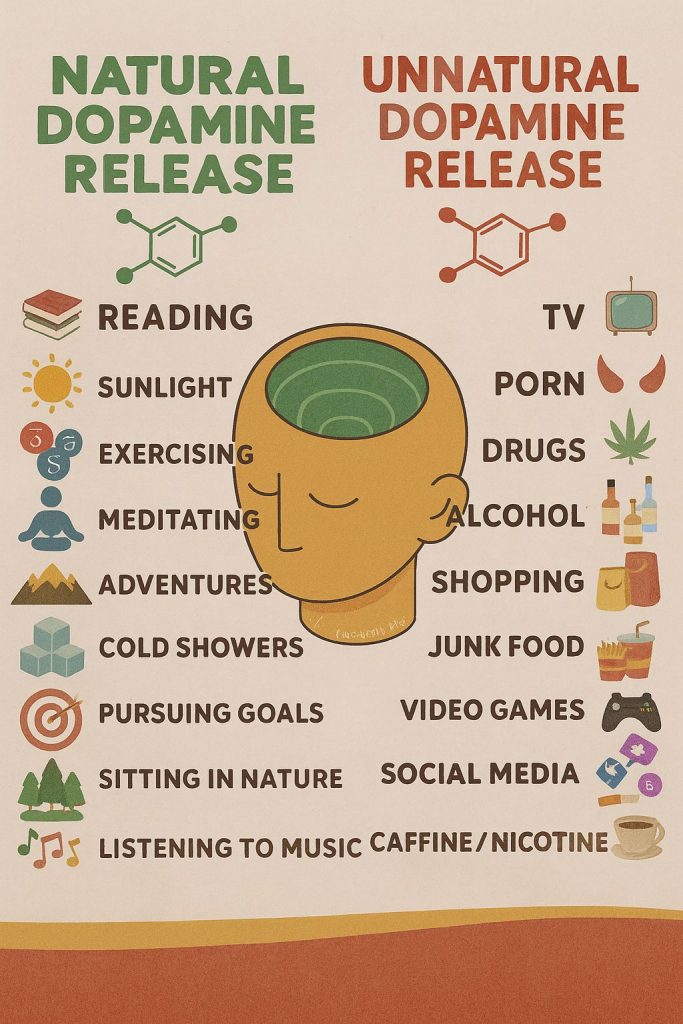
Common dopamine disruptors include:
Social media notifications
Endless scrolling
Sugary foods and drinks
Binge entertainment
Multitasking culture
These create frequent dopamine spikes, followed by crashes. Over time, dopamine receptors become less sensitive. The brain then requires more stimulation to feel motivated—but everyday tasks provide less reward.
What usually goes wrong is trying to increase stimulation instead of restoring dopamine balance.
Dopamine Imbalance and Focus – What Actually Happens in the Brain
1️⃣ Constant Digital Stimulation Desensitizes Dopamine
Digital platforms are designed to trigger dopamine repeatedly and unpredictably.
What Happens Over Time
Dopamine spikes become frequent
Baseline dopamine sensitivity drops
Normal tasks feel boring or overwhelming
The brain craves novelty instead of progress
Real-Life Example
Someone checks their phone every few minutes. Reading, studying, or working feels unbearable—not because the task is hard, but because the brain expects constant stimulation.
This is dopamine desensitization, not laziness.
2️⃣ Reduced Task Initiation Becomes the First Warning Sign
Low dopamine makes starting tasks far harder than finishing them.
Why Task Initiation Suffers
Dopamine fuels the “go” signal in the brain. When dopamine signaling weakens:
Planning feels exhausting
Procrastination increases
Even simple tasks feel mentally heavy
Example
A person knows exactly what needs to be done but feels stuck. Once they finally start, they may perform well—but starting feels painful.
This is a dopamine initiation problem.
3️⃣ Shortened Attention Span Replaces Deep Focus
Stable dopamine supports sustained attention. Imbalance leads to mental restlessness.
What This Looks Like
Frequent tab switching
Multitasking without progress
Difficulty staying present
Constant urge to check notifications
Example
Someone tries to focus for 30 minutes but feels restless after 5. The brain seeks dopamine elsewhere because focus no longer feels rewarding.
4️⃣ Poor Sleep Disrupts Dopamine Regulation
Sleep is when dopamine receptors reset and regain sensitivity.
Effects of Poor Sleep
Dopamine receptors become less responsive
Motivation drops the next day
Focus becomes fragile
Mental fatigue increases
Even small sleep inconsistencies accumulate over time.
Add small meaningful goals | Daily | Beginner-friendly
🔹 WHAT RESULTS CAN YOU EXPECT OVER TIME
With better dopamine balance, many people experience:
Improved focus duration
Easier task initiation
Restored motivation
More stable mental energy
Increased engagement with work and life
Progress feels subtle at first, then noticeable.
🔹 CONCLUSION
Low motivation is not a character flaw. Dopamine imbalance quietly shapes focus and drive over time. When dopamine signaling is supported naturally, motivation returns without force.
Instead of chasing stimulation, restore balance. Small habit changes create lasting mental clarity, focus, and motivation.
🔹 FAQ
Q1: Can dopamine imbalance cause lack of focus? Yes. Dopamine is essential for attention and motivation.
Q2: Is dopamine imbalance caused by screen overuse? Excess stimulation is a major contributor.
Q8: How long does recovery take? It varies, but consistency brings improvement.
Q9: Can dopamine imbalance affect productivity? Yes. Focus and engagement decline.
Q10: Is dopamine linked to goal-setting? Yes. Dopamine drives goal initiation and persistence.
👤
About the Author & Editorial Review
Puma U
Content on BioHelixa is created by Puma U, a certified Lab Technician (DMLT) with over 10 years of experience in public health and laboratory science, including clinical exposure within India's National Rural Health Mission (NRHM). His background in laboratory diagnostics and metabolic science provides practical insight into how cellular biology, hormones, and bio-tracking influence human performance.
📋 Editorial Review
Select health-related content on BioHelixa may be reviewed by Dr. Prashant G (MBBS), a practicing medical doctor, to support general accuracy and improve content quality. This review is intended for educational quality assurance only and does not represent formal medical certification or individualized medical advice.
⚠️ Disclaimer: This content is for educational and informational purposes only and is not intended as a substitute for professional medical advice, diagnosis, or treatment.